
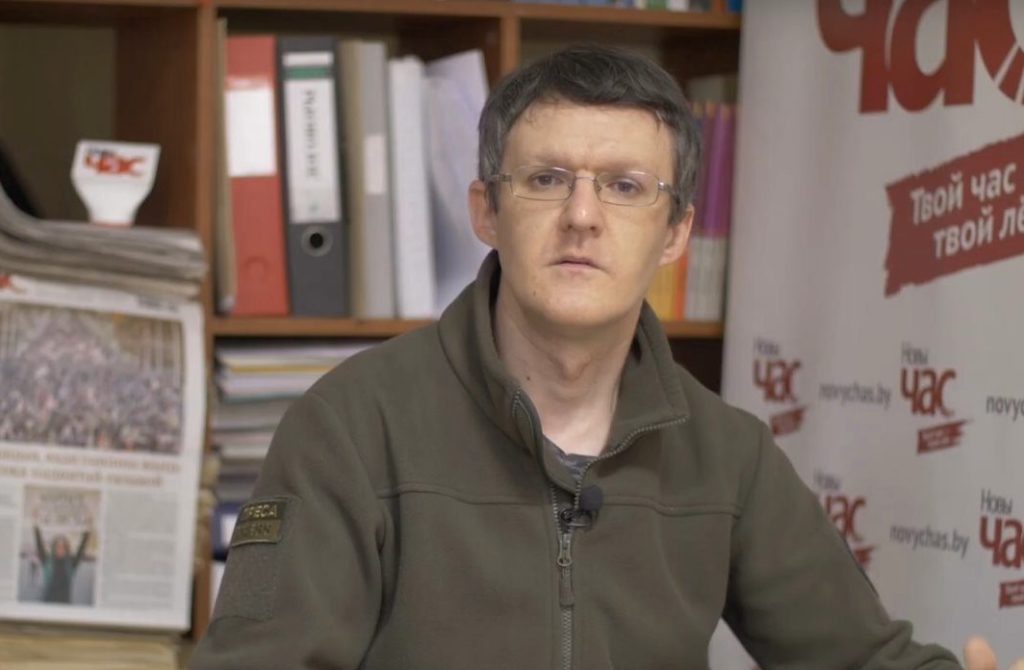
Dzyanis’ Story
Dzyanis Ivashyn is a Belarusian journalist, economist, and political scientist who was arrested in March 2021 for his investigative reporting. He is serving a 13-year prison sentence on politically motivated charges.
At the time of his arrest, Dzyanis was a freelance reporter for the independent Belarusian newspaper Novy Chas and a volunteer editor of the Belarusian-language version of InformNapalm, an investigative news site covering Russian interference in Eastern European countries. In early 2021, he reported that members of the notorious Berkut—Ukraine’s former special riot police force—were helping crack down on post-election protests in Belarus after allegedly being granted citizenship and hired as state security officers there. Soon after publishing his investigation, the Belarusian KGB raided Dzyanis’ home and arrested him on baseless charges.
Dzyanis was kept in pre-trial detention for longer than was legally allowed. His trial finally began in August 2022—behind closed doors. After weeks of secrecy, the court issued its ruling: convicted of high treason for his investigative journalism, he would face 13 years in prison. The court also ordered him to pay a 4,800-ruble ($1,900) fine and compensation of 2,000 rubles ($800) to each of nine unnamed riot police officers he allegedly “defamed” in his investigation.
In June 2023, Freedom Now and the international law firm Dechert LLP filed a petition with the UN Working Group on Arbitrary Detention (UNWGAD) on Dzyanis’ behalf. In April 2025, the UNWGAD determined that his detention is arbitrary in nature and thus violates international law. It called on the government of Belarus to immediately release and compensate Dzyanis.
In June 2023, Dzyanis was transferred to Zhodzina prison—notorious for housing hundreds of political prisoners and for its inhumane conditions. Former prisoners recount lacking hot water and being kept in overcrowded cells, refused medical care, and subjected to constant beatings. Dzyanis has faced time in solitary confinement and suffered serious medical emergencies. He is allowed to see his lawyer once a month but, ever since his single monthly phone call was taken away, he otherwise has no real contact with the outside world—except through letters.
Write to Dzyanis
In a recent interview with The European Correspondent, Dzyanis’ wife, Volha, described the importance of maintaining this correspondence. Her letters give Dzyanis a glimpse of her life—now safely in Poland—and reassure him that she is waiting for his release. His replies comfort her, showing resilience and optimism that persist despite his circumstances.
Freedom Now is inviting the public to join in by sending Dzyanis their own messages of solidarity and encouragement. As Volha recently told Freedom Now, “When Dzyanis was still in the pretrial detention center, he received letters from friends, acquaintances and simply caring people who wrote their words of support and solidarity. Dzyanis always conveyed his gratitude to the senders for their attention and kind words. They inspired him incredibly and gave him strength during this difficult time.”
These letters will not only show Dzyanis and Volha that we stand with them but will signal to Belarusian authorities that the world is watching how they treat Dzyanis and other political prisoners. As Volha also noted, “If the voice of conscience is not heard in [the prison officers], then at least they will clearly understand that the fate of political prisoners is not indifferent to many people, including those outside Belarus.”
To learn more about why and how to write letters to political prisoners, read Freedom Now’s Guide.
To send a letter, either complete this form or send a hand-written letter or postcard to Freedom Now at:
Dzyanis Ivashyn
c/o Freedom Now
1750 K St. NW, Suite 734
Washington, DC 20006
Letters received through the online form will be translated into Russian before being printed and sent on your behalf. If writing by hand, you are welcome to write in Russian, if you feel comfortable doing so. Feel free to use our sample text or make it your own. Here are some tips to keep in mind:
- Make it personal: A personal connection makes a letter especially powerful. Tell Dzyanis why his story resonates with or moves you.
- Avoid political content: Prison authorities are expected to open and read all letters. While you can reference the work Dzyanis was doing before his arrest, avoid direct references to the government or the political situation in the country.
- Stay positive: Avoid dwelling on the harsh conditions Dzyanis faces in prison. Focus instead on conveying your support, solidarity, and hope for the future.
- Keep it simple: Letters don’t need to be long or complicated—just the act of writing will send a powerful message to Dzyanis, Volha, and the Belarusian authorities.
Dear Dzyanis,
I am writing in solidarity to express my support for the ongoing struggle for human rights and democratic freedoms in Belarus.
I am inspired by the invaluable contribution you have made to this movement as a journalist. I admire your relentless commitment to telling the truth and your resilience in the face of so much adversity. Your story shows the importance of protecting the freedom and independence of the media and defending access to rights for all.
The international community will continue to advocate for your immediate and unconditional release. I stand with them in this pursuit of justice. My best wishes are with you and your family as I send you strength and hope.
Sincerely,