
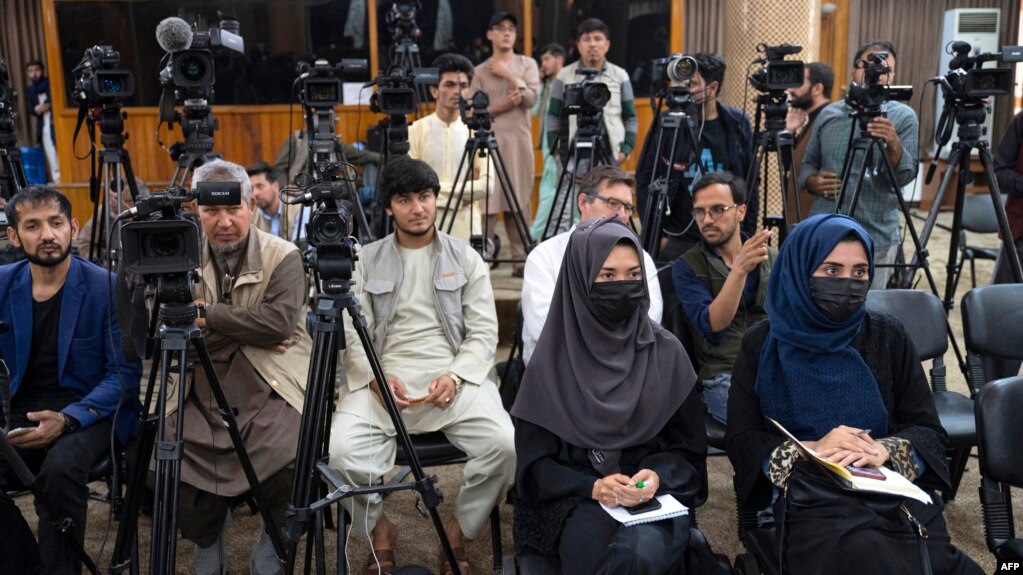
This month, we celebrated World Press Freedom Day, acknowledging the invaluable contributions of journalists and recognizing how important it is that journalists remain safe and independent. However, around the world, independent journalism and press freedom are generally under attack. Nowhere is that more evident than in Afghanistan, where the Taliban’s return to power in August 2021 plunged the country’s once-burgeoning media landscape into uncertainty, fear, and silence.
I never set out to be a journalist. Until 2021, I was a career diplomat at Afghanistan’s Ministry of Foreign Affairs, representing my country on the global stage. But long before that, I was a young girl growing up in Kabul, raised in a society where a free and independent press gave women like me a voice. After the fall of the Taliban in 2001, Afghanistan’s media scene exploded with energy and hope—hundreds of outlets sprang to life, making ours one of the freest press environments in South Asia. That media revolution shaped me. It gave me role models, information, and a sense that our future could be different. Today, that future is under siege.
The Taliban swiftly and violently undid this progress, creating instead an environment of repression, surveillance, and censorship as it reasserted ideological control over all public expression. Hundreds of journalists fled, especially investigative reporters and those affiliated with foreign outlets. Many who could or would not leave faced direct threats, beatings, arrests, and torture, as documented by the Committee to Protect Journalists (CPJ).
The Taliban re-established the Ministry for the Promotion of Virtue and Prevention of Vice which reintroduced vague yet rigid restrictions on content. Journalists cannot publish materials “contrary to Islamic values”—an intentionally undefined phrase that gives authorities latitude to arbitrarily target individuals and news organizations. The Ministry has shut down or blocked websites and monitors social media, attacking freelance and citizen journalists. According to Reporters Without Borders (RSF), about 40 percent of media outlets ceased operations within four months of the Taliban’s return due to fear of persecution or lack of funding.
The crackdown has been especially brutal for female journalists. Within the first year of the takeover, more than 80 percent of women working in media lost their jobs. Most were banned from working in television or radio stations. In a few major cities, some were allowed to return to work but only under extreme conditions—they were forced to wear the burqa, remain segregated from male colleagues, and avoid appearing on camera. Female journalists told of being followed, harassed, or threatened with death if they continued their work. Silencing them erases women’s voices from the national discourse, compromising the quality of both reporting and policymaking. These efforts to repress and erase women from society form part of a broader campaign of gender apartheid and have taken a devastating toll on Afghan women’s mental health.
Diplomatic pressure from the international community, including the United Nations, has yielded limited results. Concern is growing that world leaders will become resigned to the Taliban’s presence or even formally recognize its authority. Instead, they should be motivated by the demands and steadfast resistance of Afghan civil society to do more.
Indeed, despite the many challenges they face, some Afghan journalists have continued their work through underground or diaspora media outlets, relying on anonymous sources or encrypted communications to report on events inside Afghanistan. But even they face challenges, from practical obstacles to ongoing repression.
Two Afghan women journalists shared their stories with me, demonstrating their incredible courage and resilience in the face of unprecedent repression.
Shamail Tawana Naseri founded Farkhunda News in 2022 during what she calls “one of the darkest periods in Afghanistan’s history, when women were stripped of their most basic human rights and a heavy silence fell over society.” Refusing to be muted, she told me she established Farkhunda News “with courage and a deep belief in the power of women’s voices” to directly confront the Taliban’s censorship and attempts to erase women. Sohaila Gulistani is one of those voices. She has worked with various news outlets since the Taliban’s takeover—including Farkhunda News, the French radio program Radio for Peace International, and the Afghan news agency Khaama Press—always focusing on women and their rights.
The work has never been easy. Given serious security threats and constant Taliban pressure, Farkhunda News staff inside Afghanistan operate clandestinely, ever afraid of being discovered. They try to navigate around severe restrictions on access to resources and information, and on their movement and presence in public. Sohaila was barred from attending high-level official meetings, freely going out to report, or traveling without a male guardian. Meanwhile, as media organizations have faced growing economic pressure, women are paid significantly less than their male counterparts. Much of exiled media also faces a financial crisis, particularly as the United States and other major donors cut foreign assistance. To date, no national or international organization has supported Farkhunda News. Nevertheless, the team continues working on a voluntary basis, sustained by a profound commitment to human rights, freedom of expression, and social justice.
Today, both Shamail and Sohaila live in exile. Sohaila was forced her to leave Afghanistan in 2023 because of the mounting restrictions on and dangers to women journalists. As she explained to me, the Taliban’s disregard for free expression and press freedom left her feeling that “being a journalist in Afghanistan no longer held any real meaning.” She faced a choice between “remaining silent in the face of their crimes or risking [her] life if [she] tried to speak the truth.” She was ultimately granted asylum in France, where she can continue to pursue the dreams that give her strength.
The Taliban have made clear that they will not bend; despite any early hopes that they would soften their stance, their assault on the rights of women and girls has continued. This leaves the international community to speak to help restore Afghanistan’s dynamic and locally grounded media landscape. UN agencies and States should investigate, document, and speak out against the Taliban’s rights abuses and impose sanctions on perpetrators. They should put human rights at the center of international discussions about Afghanistan’s future and ensure Afghan women meaningfully participate in decision-making. And they should increase support to local and exiled media operating outside Taliban control and grant Afghan journalists opportunities to safely study and work abroad. This is critical to maintain Afghan media capacity despite the Taliban’s efforts.
Without sustained pressure for reform, the prospects for press freedom within Afghanistan remain grim. Motivated by the commemorations of World Press Freedom Day, we must heed Shamail’s call to “reaffirm that freedom of expression is not a privilege—it is a fundamental human right” and remember that “silence is a betrayal of the truth.” So as not to be complicit in this betrayal, we must listen to and support the women who refuse to be silenced—who “stand tall and take up their pens” to tell the truth.
Sara Hakimi is a program officer at Freedom Now, a nongovernmental organization dedicated to protecting individuals and communities from government repression, and an Advisory Board Member at the Afghanistan Center for Peace and International Studies (ACPIS). She is a former Afghan diplomat.