
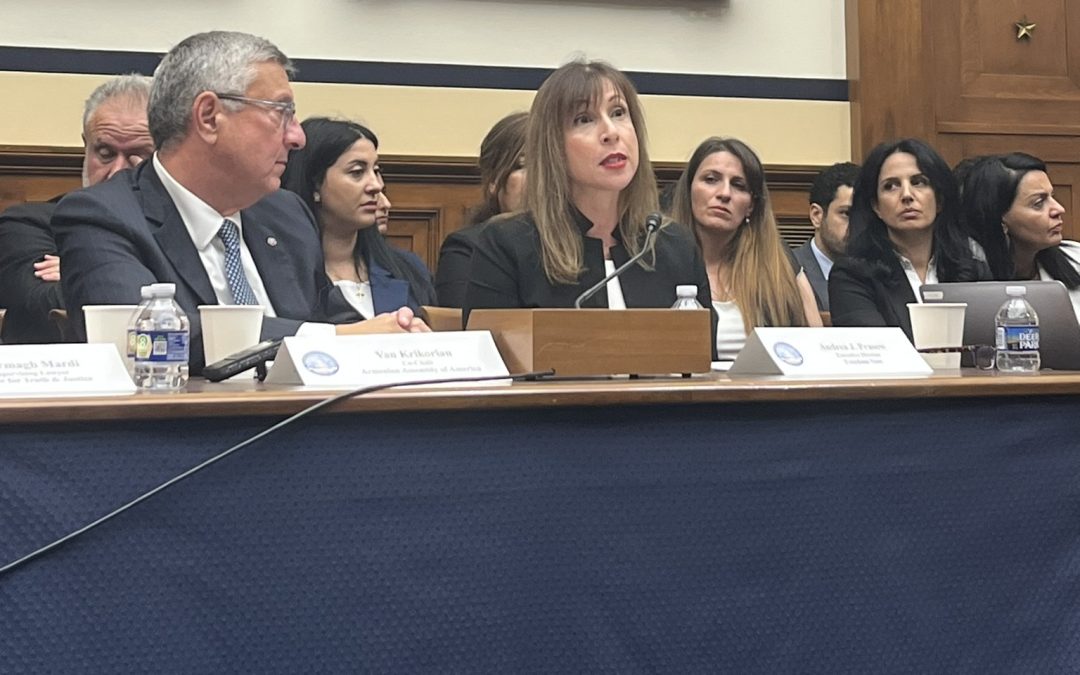
Good morning. Chairman McGovern, Chairman Smith, members of this commission. My name is Andrea Prasow and I am the executive director of Freedom Now, an organization dedicated to protecting individuals and communities from government repression. For many years, Freedom Now has worked to assist human rights defenders in Azerbaijan and sought freedom for political prisoners there. However, today I am not here representing Freedom Now, but rather will be reading a composite statement from human rights activists from Azerbaijan who so fear reprisal from their own government that they cannot attend today or use their names. Today’s testimony addresses recent developments in Azerbaijan and is drawn directly from the statements of individuals who have been targeted by the regime for their human rights activism.
And I quote:
Chairman McGovern, Chairman Smith, and members of the commission:
Allow us to take this opportunity to state plainly and directly that the human rights situation in Azerbaijan is dire and getting worse.
As you are well aware, Azerbaijan is an authoritarian regime that for over a decade has used its laws and its judicial system to steadily restrict and contain civil society. You would have great difficulty finding an activist, journalist, opposition politician, or NGO leader in Azerbaijan today who has not faced harassment by their own government.
This is a situation to which Azerbaijanis have become accustomed. However, in the last two years the situation has deteriorated greatly, beyond anything we have experienced in recent memory. At this moment, there are more than 300 political prisoners in Azerbaijan, many of them jailed since December 2022. Many of them are our friends and colleagues.
One of those imprisoned is Ulvi Hasanli, a journalist, who has been the director of the independent new outlet Abzas Media since 2016. In November 2023, masked men arrested Ulvi outside his home, beating him in the process. In addition to Hasanli, other journalists of Abzas Media, as well as its Chief Editor Sevinc Vagifqizi have also been arrested for their coverage of sensitive political topics and criticism of the government.
Then in March 2024, police raided the offices of Toplum TV and IDI (Institute of Democratic Initiatives) a non-profit organization, and arrested dozens of people, including three journalists, co-founder of Toplum TV Alasgar Mammadli, and founder of IDI and human rights defender Akif Gurbanov. Within a period of four months, three independent news outlets and one NGO were effectively shut down.
These arrests are yet another chapter in Azerbaijan’s continued campaign against independent journalists. It made it increasingly difficult for all journalists to operate when the government adopted a new media law in early 2022. The law requires journalists to register with a government-controlled agency and allows the government to bar journalists from accreditation if they have a criminal record, something the members of Abzas Media and Toplum TV will all undoubtedly have once their politically motivated trials come to the predetermined conclusion.
Azerbaijan has accelerated its repression as we draw closer to its hosting of the UN climate conference known as COP29 in November. Amidst murmurs that President Aliyev will announce a lasting peace deal with Armenia over the disputed territory of Nagorno-Karabakh, several peace activists have been arrested and charged with treason. Among them are Bahruz Samadov, a researcher completing his doctoral studies in Prague. Bahruz is a prolific commentator and contributor to a wide range of international publications, including the BBC and RFE/RL, where he spoke out against Azerbaijan’s military operations. He was arrested on August 21, 2024, and held incommunicado for two days before the government announced his detention.
While in prison detainees are facing life threatening conditions. During the first six months of 2024, Ulvi Hasanli documented 58 instances of torture and inhumane treatment in the facility in which he is being kept. These are only the cases he personally witnessed. In one incident Ulvi heard a prisoner plead with a guard to stop beating him. The guard replied “I became the first deputy by beating prisoners.”
These prison officials can operate with impunity as they know prisoners have no effective means to report this treatment. Ulvi even describes prisoners being beaten under signs for the national anti-torture hotline. To protest these conditions, some prisoners have taken drastic measures. For example, academic Fazil Gasimov has been on a hunger strike for more than 90 days, his health rapidly deteriorating.
These are just a few examples of Azerbaijan’s ever-expanding repression. There are hundreds more. Stories not just of political imprisonment but of harassment of LGBT individuals, of lack of support for domestic violence victims, of discrimination against religious groups. The list goes on and on.
Since this crackdown began we have seen the U.S. and its Western partners take a more stringent approach to Azerbaijan, for which we are grateful. But so far these actions have not impeded Aliyev’s regime. More serious actions must be taken in order to compel Azerbaijan to release political prisoners and relax its grip on civil society. This includes targeted sanctions against human rights abusers in the government and conditioning certain areas of foreign assistance on measurable human rights improvements. Otherwise we fear more of our friends will see the inside of a prison.
Thank you.